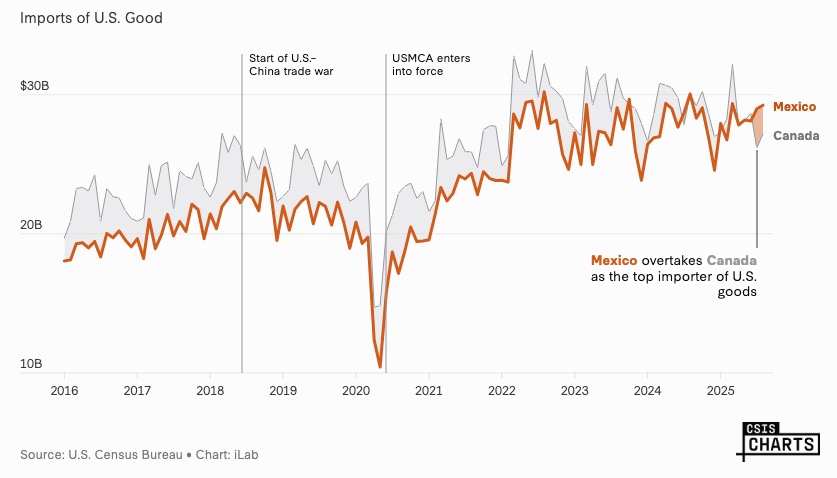
In August 2025, Mexico officially overtook Canada as the United States’ largest destination for exports, a milestone that confirms something economists have been observing for years: North American trade is no longer balanced on two equal pillars. Mexico has emerged not just as America’s top supplier—but now also its top customer.
This shift is not cosmetic. It signals a deep reconfiguration of how manufacturing, consumption, and geopolitical influence operate within North America. And it reinforces that Mexico is no longer just part of the supply chain—it is now a central engine of demand.
According to the Center for Strategic and International Studies (CSIS), Mexico has been the fastest-growing and most stable U.S. export destination since 2020, even through waves of disruption that would typically fracture trade ties: the COVID-19 pandemic, tariff regimes, supply-chain volatility, and political realignment.
In August alone, that long-term trend reached its most consequential inflection point.
The Numbers That Changed the Map
Data cited by Juno News, based on official U.S. government releases and highlighted by The New York Times, confirm the scale of the change:
- U.S. exports to Mexico (Jan–Aug 2025): $226.4 billion
- U.S. exports to Canada (Jan–Aug 2025): $225.6 billion
It’s not a landslide. But it doesn’t need to be. When global trade leaders change places, even a narrow margin is monumental.
CSIS adds further context: over the last 15 years, U.S. exports to Mexico have more than doubled, outpacing U.S. trade growth with Asia and Europe combined since 2020. That makes Mexico not only America’s largest trading partner—but also its most reliable one.
This Was Not an Accident
Monthly trends reveal something deeper than simple cyclical recovery. According to CSIS, Mexican-U.S. trade has shown resilience across:
- Section 232 steel and aluminum tariffs (2018),
- USMCA implementation (2020),
- COVID-era reshoring,
- Supply-chain fragmentation,
- New IEEPA tariffs introduced in 2025.
Despite constant friction, exports never retreated. They accelerated. The implication is uncomfortable but clear: This is not temporary adjustment. This is structural integration.
Trade with Mexico is now woven into the operational core of U.S. manufacturing. From automotive to electronics, from machinery to agriculture, Mexico has become both the factory floor and the checkout counter of American industry.
Meanwhile, Canada Is Losing Ground
Juno News describes the development bluntly:
“America’s northern neighbour is officially losing its grip.”
Political tension has played a role. In mid-2025, President Donald Trump imposed a 10% tariff on Canadian imports following a diplomatic incident triggered by a controversial Ontario government advertisement referencing Ronald Reagan. Trade talks were halted. Relations cooled.
Simultaneously, Mexico secured exemptions from similar trade penalties after negotiations between Trump and President Claudia Sheinbaum. Canada received none.
Canada remains bound under the USMCA. But practical outcomes—not treaties—shape trade flows. The result? Capital followed certainty. And certainty now lives south of the border.
Mexico Is No Longer Just a Factory—It’s a Market
One of CSIS’s most insightful observations cuts through decades of outdated thinking:
“A wealthier Mexico has become a consumer market for American goods.”
This is the real story.
Rising wages, demographic momentum, financial inclusion, urbanization and manufacturing expansion have pushed Mexico into a new category: strategic consumer economy.
Mexico is no longer “low-cost.” It is now high-impact.
And American brands—from industrial machinery to consumer goods—are increasingly treating Mexico not as an extension, but as a priority.
What This Means for the U.S. Economy
Exports don’t just move products. They support jobs. Entire ecosystems of U.S. manufacturing depend now on Mexican demand.
CSIS is explicit:
U.S.-Mexico trade is the single most stable and fastest-growing commercial relationship the U.S. has.
That gives Washington leverage. But it also imposes dependency.
North America Has a New Axis
This is not the end of Canadian relevance. But it is the end of Canadian centrality.
Mexico’s rise is not symbolic. It is mathematical.
And economic history does not lie.
North America’s gravitational center has shifted south—not because of ideology, but because of purchasing power, resilience, and industrial symbiosis.
Mexico is no longer waiting for permission. It has already taken position.
The question is no longer whether Mexico will lead U.S. trade. That has already happened. The real question is how Washington adapts to the reality that its economy is now structurally tied—not to a neighbor, but to a partner that has learned to consume as confidently as it produces.
And if history teaches anything, it’s this: Trade dominance is never announced. It is simply realized—once it’s too late to ignore.
MUST Read Articles:
-
U.S. National Parks to Charge International Tourists $100 More
-
Blue, the iconic VW that survived a California wildfire, is reborn as a symbol of resilience
-
The U.S. Embassy’s Historic Move Marks the End of an Era in Mexico City
-
How to Get FIFA World Cup 2026 Tickets Through Brand Promotions in the USA and Canada
-
Black Friday 2025: How America’s Biggest Shopping Day Was Born — and Where the Best Deals Are