In a market where tech brands compete on specs, updates, and increasingly complex ecosystems, Xiaomi chose to move in the opposite direction. It didn’t unveil a new car, smartphone, or AI device—it launched an ice cream.
The move, seemingly trivial, achieved what many multimillion-dollar launches fail to deliver: organic, global conversation. Much like the jar of Nutella floating in space, within hours, the so-called “Xiaomi Ice Cream,” created by chef Bing Jiabao, became a viral phenomenon in China—not because of culinary innovation, but because of the logic behind its existence.
An ice cream that looks like a car or smartphone
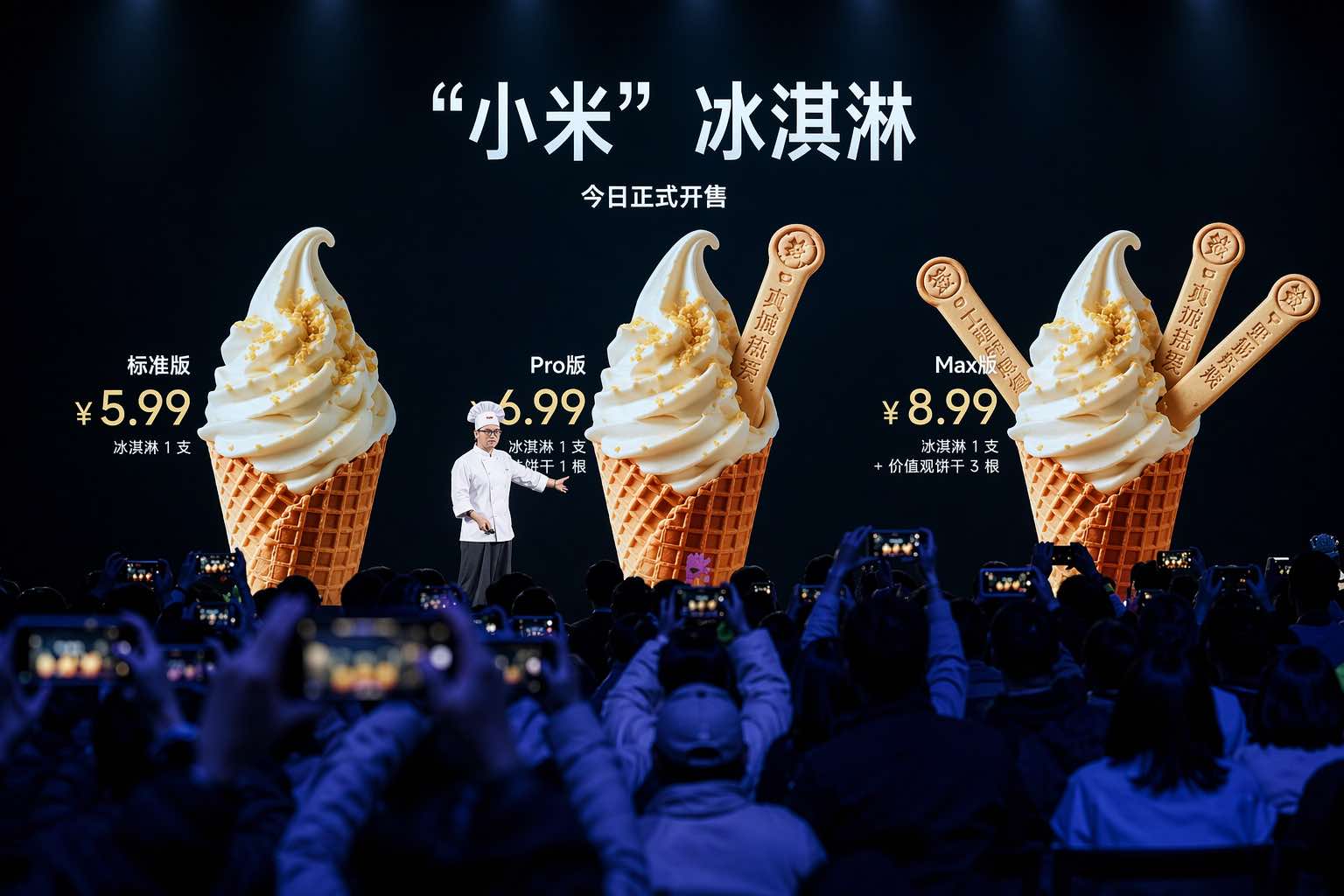
Far from being an improvised product, the ice cream was designed under the same principles that govern the brand’s tech portfolio. Xiaomi replicated its segmentation logic, naming conventions, and positioning, creating versions that mirror its device categories.
The result is a product that doesn’t break from the brand’s identity—it extends it. This isn’t just an ice cream; it’s another piece within Xiaomi’s broader narrative ecosystem. That consistency matters. Xiaomi isn’t entering a new category—it’s translating its language into a new format.
Where to find Xiaomi ice cream
Availability is key to understanding the phenomenon. The product was not launched in retail or digital platforms. Distribution was limited to the company’s corporate bar in China, originally intended for employees and visitors at its electric vehicle facility. That limitation didn’t restrict reach—it amplified it.
In a world where access is instant, scarcity creates symbolic value. The product wasn’t designed for mass sales, but to be seen, shared, and talked about.
The Xiaomi ice cream is available in Standard (US$0.88), Pro (US$1.02), and Max (US$1.32) versions.
What happened next: instant virality
The reaction was immediate. Within days, demand exceeded production capacity. Thousands of units were sold, and operational issues quickly followed. The ice cream machine reportedly broke down just 72 hours after launch.
The phenomenon moved to social media, where images and videos spread organically. Without significant advertising spend, Xiaomi managed to position a non-commercial product as a digital trend. In this case, virality wasn’t driven by the product itself, but by the context in which it was introduced.
Xiaomi’s culture play
The launch aligns with a broader strategy. Xiaomi has built its growth by expanding across multiple categories, from smart devices to home products and mobility. The ice cream fits into this logic as a symbolic extension. It’s not meant to generate direct revenue, but to reinforce the brand’s presence in everyday life.
Rather than operating strictly as a tech company, Xiaomi functions as a lifestyle brand. In that positioning, any object can become a point of connection.
The real business behind the ice cream
From a financial perspective, the impact is marginal. Strategically, it is significant.
The launch strengthens Xiaomi’s image as a flexible brand, capable of moving across categories without losing coherence. It generates visibility without relying on traditional media investment and deepens engagement with an audience that actively participates in shaping its narrative. The ability to spark conversation has become a competitive advantage.
The Xiaomi ice cream does not redefine the food industry, but it does signal a shift in how brands build relevance. The product is no longer the end—it’s the means. What matters is not what is sold, but what it activates.
In a market saturated with launches, Xiaomi demonstrated that innovation doesn’t always come from technology. Sometimes, it comes from understanding that attention isn’t bought—it’s earned. And much like ultra-luxury brands, Xiaomi proved that an ice cream can generate as much global relevance as the launch of a Lamborghini.
Keep reading:
-
Meet the 2026 MG3, Mexico’s most affordable car: pricing, specs, and versions
-
Zacapa Ámbar returns to Mexico: pricing, availability, and details
-
Don Julio, Buchanan’s, Johnnie Walker and Smirnoff launch 2026 World Cup bottles
-
Tesla and BYD face new competition as XPENG enters Mexico with AI-driven models