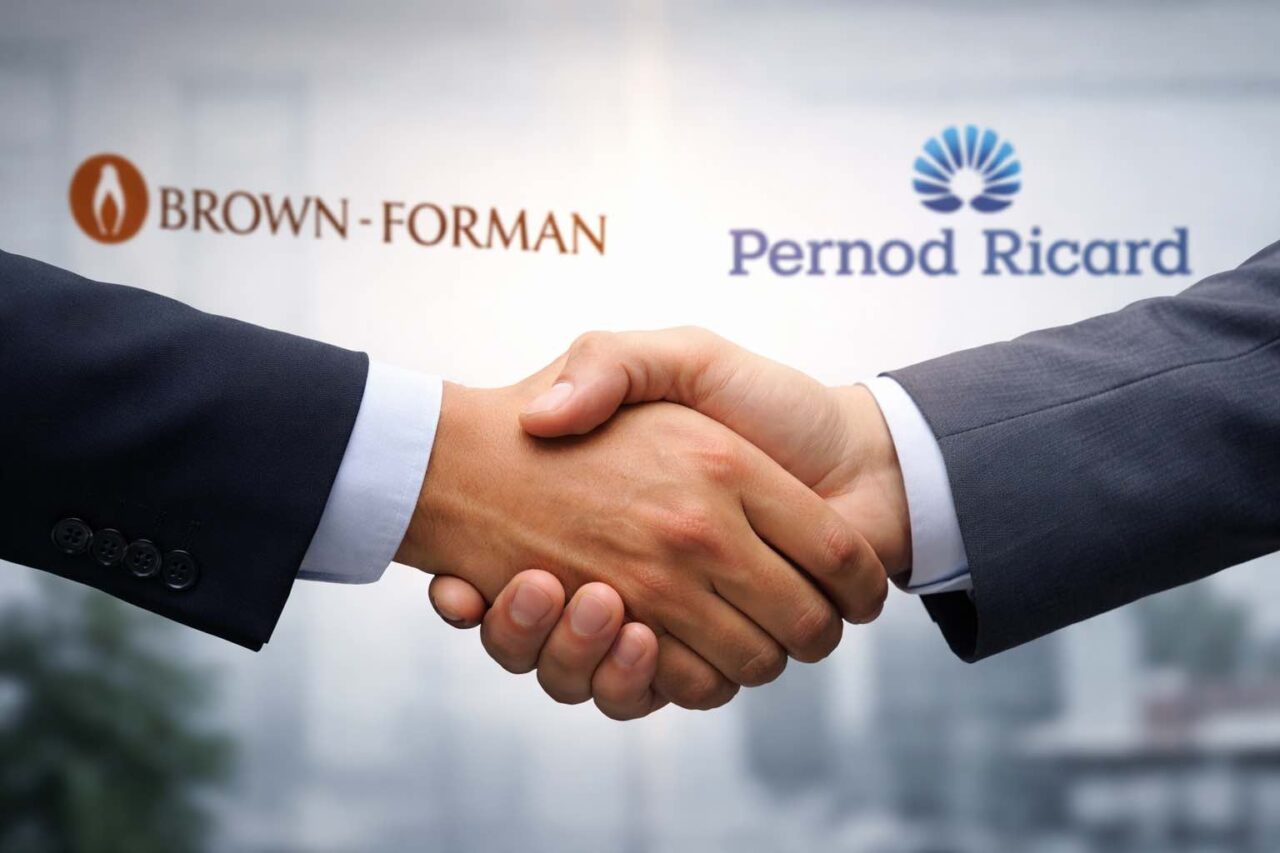
The global alcoholic beverages business is going through a period of quiet adjustment. For years, growth seemed guaranteed by premiumization and international expansion. Today, consumption is slowing, forcing major players to rethink their scale. In this context, Pernod Ricard and Brown-Forman have confirmed talks for a potential merger.
If completed, the deal would bring together key portfolios in the sector, including brands such as Jack Daniel’s, Jameson and Absolut, in a move aimed at strengthening their position in an increasingly competitive environment.
A merger seeking scale in a pressured market
The appeal of the deal is clear. Brown-Forman would contribute its strength in American whiskey and tequila, two categories with strong international demand. Pernod, for its part, would add its global distribution network and a diversified portfolio across vodka, champagne and premium spirits. The result would be a group with broader global reach and a stronger position against Diageo, the sector leader, and other competitors.
In addition, analysts at Jefferies estimate that the integration could generate annual cost savings of up to $450 million. In an industry where margins are increasingly critical, these synergies can make a meaningful difference in profitability.
The family factor complicates the deal
Beyond financial logic, the main challenge lies in the ownership structure of both companies. According to Reuters, Brown-Forman has maintained strong family control since its founding in 1870. The Brown family retains a significant share of voting rights and has historically taken a cautious stance toward any deal that could dilute its influence.
In the past, the company has rejected approaches from potential buyers, reflecting a strategy focused on preserving its independence.
On the French side, Pernod is also influenced by the Ricard family, though in a more institutional role. Alexandre Ricard has led the company for more than a decade, but there is no clear family successor within the current structure.
Balancing the interests of families and shareholders adds an additional layer of complexity to any agreement.
The financial risk of paying a high premium
Another key factor is the potential cost of the transaction. Reuters notes that to complete a deal of this magnitude, Pernod would likely need to offer a significant premium. This could increase its debt levels, which are already elevated at around 3.8 times EBITDA.
Higher leverage could limit the combined group’s financial flexibility and reduce expected benefits for Pernod shareholders, particularly if a large portion of the value created by synergies ultimately benefits Brown-Forman investors.
Slowing consumption remains the core issue
Beyond the deal itself, the industry’s main challenge remains unchanged. Global alcohol consumption growth has slowed. Factors such as changing consumer habits, increased health awareness and economic pressures are weighing on demand.
In this context, a merger may improve operational efficiency and strengthen competitive positioning, but it will not necessarily reignite market growth. That is why many analysts view these moves as driven more by optimization needs than by true expansion.
An industry in the midst of reconfiguration
The potential merger between Pernod Ricard and Brown-Forman comes at a time of broader change across the consumer sector. Companies such as Unilever, Estée Lauder and Puig are also evaluating strategic moves, including asset sales and potential mergers.
These developments reflect an environment in which large companies are adapting to new consumption patterns and more moderate growth expectations.
Scale, efficiency and a deeper challenge
The combination of Pernod and Brown-Forman could create a more efficient group with greater reach and stronger positioning against competitors. However, the underlying challenge remains. The industry faces a different kind of consumer—more selective and less predictable.
In this environment, scale can help withstand pressure, but adaptability will ultimately determine which companies remain relevant in the long term.
Keep reading:
-
End of the long-standing Taxi vs Uber battle: both merge ahead of the 2026 World Cup
-
Viva Aerobus and Volaris surprise the market: they merge to create a Mexican aviation giant
-
AI and creativity: the fusion redefining marketing
-
Honda and Nissan halt merger talks: what’s next for Japanese automakers?