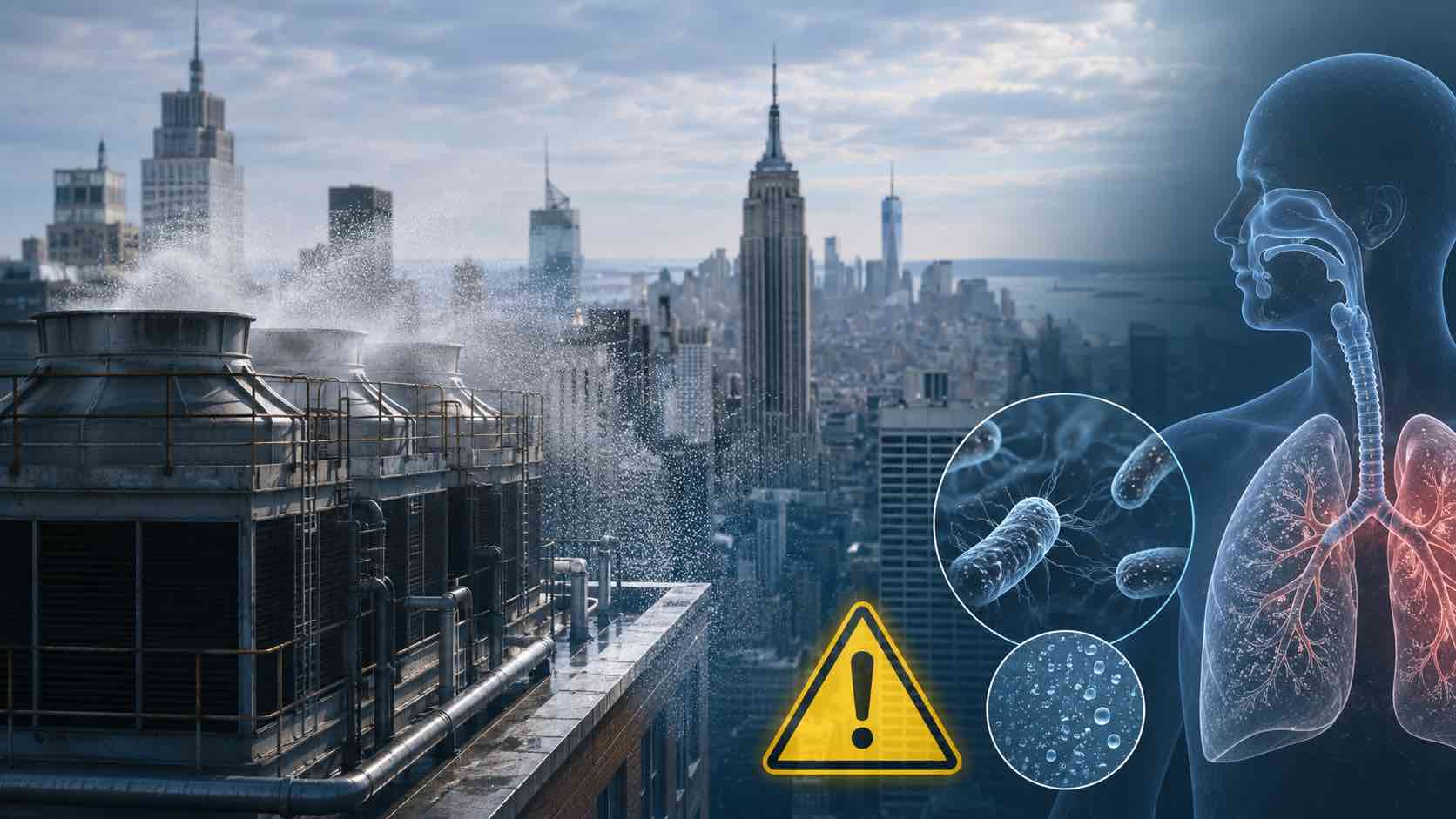
New York City is confronting its second major Legionnaires’ disease outbreak in less than a year, reopening uncomfortable questions about cooling-tower maintenance, regulatory compliance and the vulnerability of dense urban neighborhoods to a bacterium that spreads invisibly through water mist.
As of the latest New York City Health Department update, published on July 22, 2026, 84 people had tested positive in an outbreak concentrated on Manhattan’s Upper East Side. Five people had died, seven remained hospitalized, 59 had been discharged and 13 had not required hospitalization. The affected area includes Carnegie Hill and Yorkville, particularly ZIP codes 10028, 10128 and 10075. Officials warn that the figures remain preliminary and may change as additional cases are investigated.
The outbreak was first detected on July 2, when the city identified two cases occurring near one another. Three days later, health officials expanded the investigation after confirming another case involving someone who lived, worked or had visited the adjoining ZIP code 10075. The rapid rise from two confirmed infections to dozens of illnesses illustrated one of the central difficulties of Legionnaires’ disease: symptoms can take between two and 14 days to appear, while laboratory confirmation may arrive even later.
What is Legionnaires’ disease?
Legionnaires’ disease is a severe form of pneumonia caused by Legionella bacteria. People generally become infected by breathing in tiny droplets of contaminated water, not by drinking it. The disease is not normally transmitted from one person to another.
Symptoms commonly include cough, fever, headaches, muscle aches and shortness of breath. Some patients also experience confusion, diarrhea or nausea. Because these signs resemble influenza and other types of pneumonia, people may initially underestimate the illness or receive a delayed diagnosis.
Most healthy people exposed to the bacteria do not become sick. The greatest risks are faced by adults aged 50 or older, current or former smokers, people who smoke or vape, and those with chronic lung, heart, kidney or liver disease, diabetes or weakened immune systems.
The disease is treatable with antibiotics, particularly when identified early. Nevertheless, the Centers for Disease Control and Prevention estimates that approximately one in every 10 people who develops Legionnaires’ disease dies from its complications. The fatality rate is higher in infections acquired in healthcare facilities.
Why New York’s cooling towers are under scrutiny
The current outbreak is being investigated as a community cluster associated with cooling towers. These structures are generally located on rooftops and form part of large air-conditioning or refrigeration systems. They remove heat by circulating and evaporating water, producing mist that can be released into the surrounding environment.
That combination of warm water, recirculation and aerosol production can create ideal conditions for Legionella when a system is not adequately cleaned, disinfected and monitored. The bacteria grow particularly well in water between approximately 25 and 45 degrees Celsius.
This does not mean that ordinary residential air conditioners are dangerous. Window units, home systems and car air conditioners that do not circulate water or release water mist are not considered sources of Legionella exposure.
New York City tested 183 cooling towers at 160 buildings within the investigation area. Initial PCR screening detected Legionella DNA in 77 towers at 75 buildings. Subsequent culture tests confirmed live bacteria in 51 towers at 50 buildings. All towers confirmed to contain live bacteria were cleaned and disinfected, while additional culture results remained pending at the time of the latest update.
A positive test does not automatically prove that a particular tower infected patients. PCR tests can identify genetic material from both live and dead bacteria, while culture testing confirms that live organisms were present. Even a positive culture result does not establish that the tower was the source of the outbreak; definitive attribution normally requires epidemiological evidence and molecular comparison between bacteria collected from patients and environmental samples.
The city has therefore identified numerous potentially hazardous towers but has not publicly attributed the entire outbreak to one definitive source.
Is New York’s tap water safe?
According to the New York City Health Department, the current Upper East Side cluster is not linked to the plumbing systems inside affected buildings. Residents can continue drinking tap water, cooking, bathing and showering normally. They can also continue using their home air-conditioning systems.
This distinction matters. A cooling-tower outbreak can expose people in the surrounding neighborhood because contaminated mist may travel through outdoor air. A building-plumbing outbreak is different: it is generally limited to people exposed to contaminated water inside a particular property, frequently through showers or faucets.
People who have lived, worked or spent time in ZIP codes 10028, 10075 or 10128 since late June and develop cough, fever, breathing difficulties or other pneumonia-like symptoms should seek medical evaluation promptly and mention their possible exposure to Legionella.
Officials say the exposure has probably ended
City health officials say the decline in newly symptomatic patients suggests that remediation has likely eliminated the active source of exposure. However, the case total can continue to rise after transmission has stopped because people may develop symptoms days later or receive delayed test results.
That creates an apparent contradiction: the city can report that no recent exposure is evident while still adding confirmed cases or deaths. A person counted today may have become ill more than a week earlier.
The administration maintains that it acted aggressively by using both rapid PCR screening and slower culture testing, ordering towers with initial positive results to undergo full cleaning rather than waiting up to two weeks for confirmatory cultures.
Yet the response has become politically contentious. New York City Council leaders have called the outbreak a public-health emergency and announced an oversight hearing to examine the speed of the response, cooling-tower compliance and whether existing enforcement measures are sufficient.
Why this outbreak is especially troubling
The Upper East Side cluster arrived less than a year after a major outbreak in Central Harlem. New York City later reported 118 cases, 92 hospitalizations and seven deaths from that 2025 cluster. Molecular testing linked bacteria found in patients to cooling towers at Harlem Hospital and a nearby construction site.
That outbreak led the city to strengthen its rules. Beginning May 8, 2026, owners of operating cooling towers were required to test for Legionella at least every 31 days—three times more frequently than under the previous schedule—and report sampling dates to the city. New York has approximately 5,000 registered cooling-tower systems.
During the first six months of 2026, inspectors completed nearly 1,600 cooling-tower inspections, 35 percent more than during the comparable period of 2025. Yet enforcement records also reveal the scale of the compliance challenge: during fiscal year 2025, the Health Department issued 1,337 cooling-tower violations and collected approximately $680,000 in related fines.
The contradiction is difficult to ignore. New York has some of the most demanding cooling-tower regulations in the United States, but it has now experienced two deadly clusters in consecutive summers. Strong rules do not automatically produce safe systems when thousands of privately and publicly managed towers require constant testing, chemical treatment, recordkeeping and technical supervision.
The larger lesson from New York’s Legionella crisis
The immediate public-health message is reassuring but precise: the outbreak is not considered a drinking-water emergency, ordinary air conditioners are safe, and contaminated towers have been remediated. The urgent warning is directed toward anyone who spent time in the affected neighborhoods and develops pneumonia-like symptoms.
The broader conclusion is less comfortable. Legionella is not an exotic threat that appears without warning. It is an infrastructure-management problem. The bacteria exploit warm water, stagnation, inadequate disinfection, poor maintenance and gaps between written regulation and daily operation.
New York’s real test will not be whether it can disinfect dozens of towers after people become sick. It will be whether it can detect hazardous conditions before the next cluster begins.
A city can increase inspections, testing frequency and penalties, but prevention ultimately depends on thousands of building owners treating cooling-tower maintenance as a public-health responsibility rather than a mechanical obligation. Until that happens consistently, New York may continue to control individual outbreaks without eliminating the conditions that allow them to return.