There are matches that are played on the pitch and others that are written beforehand, in the margins, where no one is looking. On June 22, 1986, at the Estadio Azteca, both happened at the same time. While Diego Armando Maradona was preparing to face England under the harsh sun of Mexico City, a parallel story —invisible, improvised— was already unfolding. That day, football did not just produce two of the most memorable goals of all time. It also revealed an uncomfortable truth. Argentina stepped onto the field wearing a jersey that should not have existed — and this is where the “Barrio Bravo” of Tepito entered the story.
The logistical mistake that changed the history of the 1986 World Cup
It was not an aesthetic decision or a marketing move, it was a mistake.
Within the logic of the World Cup —that machine that today seems flawless— something failed. After the match against Uruguay, several Argentine players swapped jerseys. A common gesture, almost ritualistic. But the schedule does not wait for rituals. England required Argentina to wear the alternate kit again, the blue one. And that kit simply was not enough. There were not enough jerseys.
The scene, reconstructed years later by outlets such as ESPN, Record, Goal and Mediotiempo, based on testimonies from players like Óscar Ruggeri, carries both absurdity and urgency.
“We didn’t have kits… we had to wear blue again. We had to go out and buy them.”
Today it would be unthinkable, but in 1986 it was inevitable.
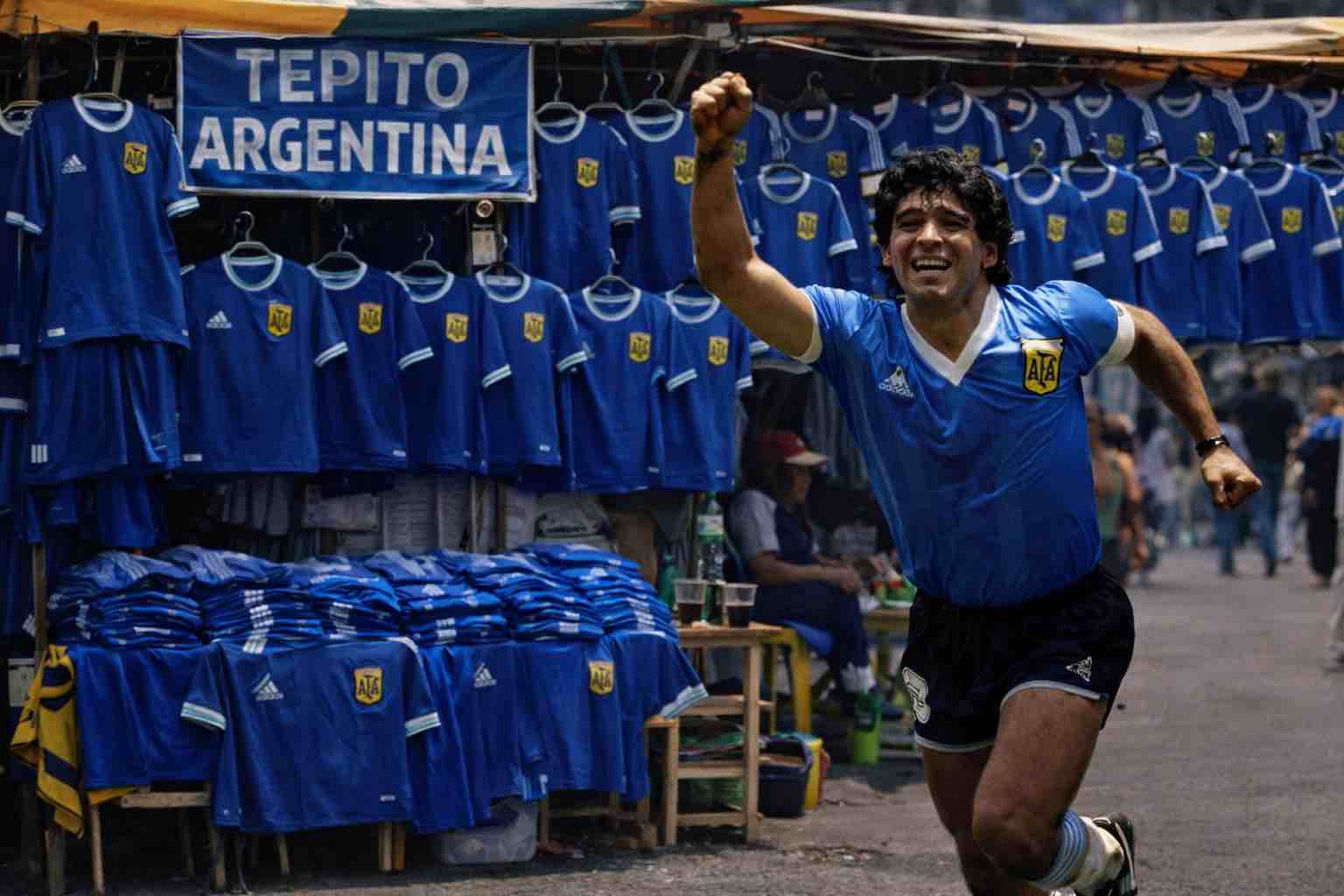
Tepito, the barrio that solved what logistics could not
And then the city appeared —not as a setting, but as a solution. Héctor Miguel Zelada, Argentina’s backup goalkeeper and a player for Club América, knew Mexico City beyond hotels and stadiums. He knew its shortcuts, its codes, its quick solutions — he knew Tepito.
Tepito is not a place that is easy to explain; it is a place that solves things. A neighborhood in the heart of the city, just a few blocks from Mexico City’s Historic Center, where everything is sold and anything is possible. From electronics and furniture to counterfeit designer clothing and even illicit goods.
That is where the team’s kit staff were sent, guided by Zelada. Not to negotiate contracts or seek sponsors, but to buy jerseys.
They came back with several: blue, alternative, unofficial — but functional and better suited for the heat. Because there was another problem. The official kit was not only scarce, it was heavy, thick, poorly breathable and unsuitable for playing at midday, at altitude, under an unforgiving sun. The Tepito jerseys, on the other hand, were lighter.
An improvised jersey for an eternal match
The jerseys were not ready for a World Cup. They lacked proper numbers, did not meet official standards, and did not follow any brand narrative. They had to be modified, adapted. The numbers were ironed on just hours before the match against England, and the AFA (Argentine Football Association) crest was sewn on by hand. They solved in hours what today would take months of approvals. It was almost artisanal work. Meanwhile, the clock kept ticking.
When Argentina stepped onto the pitch, almost no one noticed the difference. The shade of blue was not exactly the same, the numbers reflected light differently. Something was off, but not enough to disrupt the scene.
The Argentina vs. England match was loaded with political tension. England had defeated Argentina in the Falklands War in 1982, a conflict in which 649 Argentine soldiers, 255 British soldiers and three civilians lost their lives.
For many, the match became a form of symbolic revenge. The tension was palpable, even during the national anthems at the Estadio Azteca. According to later testimonies, Maradona urged his teammates after the anthems, reminding them of what had happened in the war:
“Come on, let’s go — they killed our boys, our friends, our neighbors in the war. We cannot lose.”
There were also clashes in the stands before kickoff, as Argentine fans and English hooligans confronted each other.
@laiglesiadelgol 💇♂️💈¿Sabías que esta famosa pelea con los hooligans se produjo gracias a Roberto Giordano? Esta historia paso en México, Mundial ’86. El Estadio Azteca vibra con la tensión histórica entre Argentina e Inglaterra, cuatro años después de la Guerra de las Malvinas. Entre la multitud se encontraba Roberto Giordano, peluquero pero sobre todo uno de los hinchas más icónicos que tuvo nuestra Selección. Giordano ve a un periodista de Gente y le dice: «Sacame una foto que le voy a robar una bandera a un inglés. Este gesto, lejos de ser inofensivo, se interpreta como una burla descarada hacia los ingleses. Los hooligans reaccionan de inmediato y la tensión se vuelve explosiva. Entre gritos y empujones, se desata una pelea que se extiende por las tribunas. Al día siguiente, Crónica publicó una foto impactante: se veía a Raúl Gámez, en ese momento Barrabrava de Velez, en plena acción en medio del caos. Con el tiempo, Gamez contó como se dió, “Un famoso peluquero argentino le quiso sacar una bandera a un inglés y la barra de ellos se nos vino al humo. Yo los enfrenté, creí que estaba defendiendo a la patria. Gámez, nunca reveló quién fue el «famoso peluquero argentino» que, según él, dio origen a la pelea. Pero «famosos peluqueros argentinos» no hay tantos y, relacionados con el fútbol, aún menos. Salvo uno. Asi Roberto Giordano, el peluquero que sin querer, nos iba a dejar una de las imágenes más recordadas de ese día Este guion es contada con más detalles en el libro “El Partido” de Andrés Burgo Futbol FutbolArgentino Giordano SeleccionArgentina #Mexico86
Then the whistle of Tunisian referee Ali Bennaceur sounded, and the match began. What followed is known worldwide. Maradona took the ball and defied logic, space and history. First with his hand, then with his feet. Two goals that paved his path to immortality. Argentina defeated England and advanced toward winning the 1986 World Cup.
The jersey —the one that should not have been there— was absorbed by the greatness of the moment. Invisible in the broadcast, irrelevant in immediate reports, but persistent in the collective memory of football fans.
Maradona’s iconic jersey, which cost just a few pesos in Tepito and ended up with Steve Hodge after the match, was auctioned by Sotheby’s London in 2022 for nearly $9 million.
This is not folklore. It is documented memory. A one-time solution that became embedded in football mythology.
What this story reveals is not a scandal, but a lesson. Before branding, there was necessity. Before storytelling, there was urgency. Tepito did not design a campaign, sign a sponsorship or seek recognition — it simply solved a problem. And in that act —fast, imperfect, effective— it became part of one of the greatest chapters in sports history.
Because in the end, history does not remember who made the jersey.
It remembers who scored the goal.
And that day, Maradona scored the greatest of all — wearing a jersey that should never have been there.
Keep reading:
-
Guadalajara, the preferred host city for the 2026 World Cup
-
Panini and Mexico’s National Lottery launch commemorative ticket and album
-
Mexico vs Portugal: how to get to Estadio Banorte
-
The history of World Cups – Mexico 1986
-
Confirmed: YouTube joins the 2026 World Cup
-
How Sabritas plans to reshape World Cup marketing