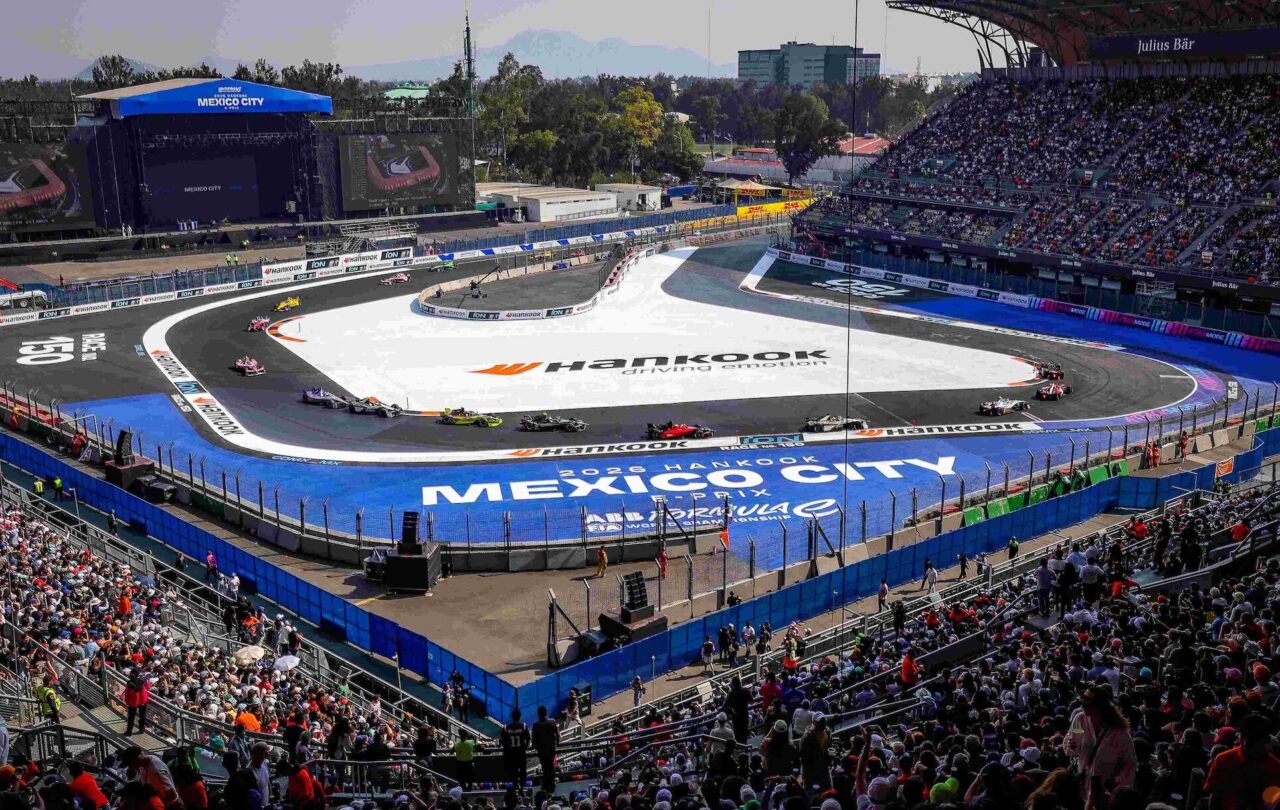
When Formula E returns to Mexico City, it never arrives quietly. It comes with altitude, adrenaline, and a kind of electric intensity that few circuits in the world can replicate. At more than 2,200 meters above sea level, the Autódromo Hermanos Rodríguez is not just a racetrack — it is a pressure chamber for technology, strategy, and human precision. And during the 2026 Hankook Mexico City E-Prix, it once again proved why it is one of the most revealing testing grounds in global motorsport.
This year’s Round 2 of the ABB FIA Formula E World Championship Season 12 unfolded inside a vibrant, festival-like atmosphere, but beneath the spectacle lay one of the most technically demanding races of the season. High altitude reduces air density, complicates cooling systems, and amplifies the role of energy management. Every kilowatt, every degree of temperature, and every square inch of tire contact matters more here than anywhere else on the calendar.
That is precisely why Hankook’s iON Race tire became one of the quiet protagonists of the weekend.
Where Altitude Becomes a Technology Test
Mexico City is Formula E’s highest-altitude race, and that alone reshapes how teams approach competition. Reduced oxygen affects battery cooling, powertrain efficiency, and even driver endurance. But it also places enormous stress on tire performance.
As air pressure drops, so does aerodynamic downforce. That means more of the car’s grip must come from the tire itself. Add to that the long straights, heavy braking zones, and the sudden transition into the tight Foro Sol stadium section, and the tire is forced to perform across radically different demands within the same lap.
The iON Race, Hankook’s purpose-built electric racing tire, was engineered for exactly this kind of environment. Throughout the E-Prix, it delivered consistent grip, stable thermal behavior, and predictable feedback — allowing teams to focus on energy strategy rather than firefighting tire degradation.
“Mexico City once again proved how decisive stable tire behavior is at high altitude,” said Manfred Sandbichler, Senior Director of Hankook Motorsport. “Across a race that demanded constant adaptation, the iON Race delivered the confidence and consistency teams needed to manage energy, temperature, and balance under challenging conditions.”
That confidence is not just about lap time — it is about unlocking strategic freedom.
Strategy, Energy, and the Path to Victory
The 2026 Mexico City E-Prix was Formula E’s 150th race, and it delivered a fitting reminder of how deeply the championship has evolved into a data-driven chess match. This was not a race won by brute speed, but by precise control over energy deployment, braking regeneration, and tire temperature.
Nick Cassidy executed that equation to perfection, securing Citroën’s maiden Formula E victory in a race that rewarded discipline as much as aggression. He crossed the line ahead of Edoardo Mortara (Mahindra Racing) and Oliver Rowland (Nissan) after a contest defined by efficiency rather than excess.
Behind that result was a tire that could be trusted. The iON Race’s predictable warm-up characteristics and steady grip profile allowed drivers to attack when needed and conserve when required — without the performance cliff that often undermines strategy at high altitude.
In a championship where races are frequently decided by fractions of a percent in usable energy, that stability becomes a competitive weapon.
The Track That Never Stops Asking Questions
The Autódromo Hermanos Rodríguez is unique even within Formula E’s diverse calendar. Long straights demand low rolling resistance. Tight stadium corners demand lateral grip. The legendary Peraltada curve tests balance at speed. Meanwhile, track evolution and altitude-driven temperature fluctuations continuously shift the grip window.
Over the course of the race, Hankook engineers collected a rich dataset on tire temperature, wear patterns, and performance consistency — information that now feeds directly into the ongoing development of Hankook’s iON EV tire family, which serves both motorsport and road-going electric vehicles.
Formula E is not just a championship. It is a live research laboratory. And Mexico City, with its extreme conditions, is one of its most valuable testing environments.
More Than a Race
Beyond the telemetry and the trophies, Mexico City once again showed why it holds a special place in Formula E’s identity. The Foro Sol was packed. The energy was visceral. The city embraced the series not just as motorsport, but as a cultural event.
For Hankook, that matters. As both title sponsor of the Mexico City E-Prix and exclusive tire partner of Formula E, the brand is not only supporting competition — it is shaping how electric mobility performs when pushed to its limits.
With Round 2 now complete, the championship moves on to Miami for Round 3 on January 31, 2026, where a very different track layout will test the iON Race in new ways. But the data, lessons, and proof points from Mexico City will travel with every team.
At high altitude, nothing hides. And in 2026, Hankook’s iON Race proved that when the air gets thin, consistency becomes everything.
Keep Reading:
-
How Live Events Became the Most Powerful Media Channel
-
Retail Marketing 2026: from shelf to intelligent ecosystem
-
LEGO Just Changed How Kids Play Forever (And You Can’t See the Tech)
-
American Eagle Shifts the Narrative After Controversy and Bets on Martha Stewart for Christmas
-
PepsiCo and Mercedes-AMG PETRONAS F1 Team Join Forces in Global Deal Starting 2026